
Background & Summary
aTyr Pharma Inc. is a clinical-stage biotechnology company developing novel immunomodulatory therapeutics. Its lead candidate, efzofitimod, is a selective modulator of Neuropilin-2 (NRP2) currently in a Phase III trial for treatment of pulmonary sarcoidosis, with top-line results expected in mid-September. Pulmonary sarcoidosis is a rare inflammatory lung disease with over 40 million cases worldwide. As they age, 60% of pulmonary sarcoidosis patients report improved symptoms, while 40% see no improvements or more severe symptoms, indicating significant unmet demand for an FDA-approved treatment. Patients instead rely on generic steroids and off-label immunosuppressants that control inflammation but don’t cure the disease, while carrying significant side effects. If successful, efzofitimod would be the only approved treatment of pulmonary sarcoidosis, giving aTyr pricing power over the industry. In March 2023, aTyr conducted phase 2 trials in which their results found virtually no significant evidence of effective treatment. Nonetheless, equity research analysts from firms like Wells Fargo have set lofty price targets, sending the stock up over 222% in the last year. Our research suggests an opportunity to bet against the optimism of aTyr’s phase 3 trials, with a target price of $0.85, equal to their net cash value per share, for an implied upside of 85.90%.
2Y Price Chart

Clinical Trial Design
ATYR’s Phase 2 trial enrolled a total of 37 patients, with 12 receiving a placebo and 25 receiving varying doses of Efzofitmod. The primary endpoint was the incidence of adverse events (AEs), while secondary endpoints included measures of efficacy such as steroid reduction, change in lung function (FVC), and patient-reported outcomes (PROs) on health-related quality-of-life scales. The Phase 3 trial enrolled 88 patients across placebo and two dosage groups. Steroid reduction was the primary endpoint, with lung function and patient-reported outcomes designated as secondary endpoints.
Investment Thesis
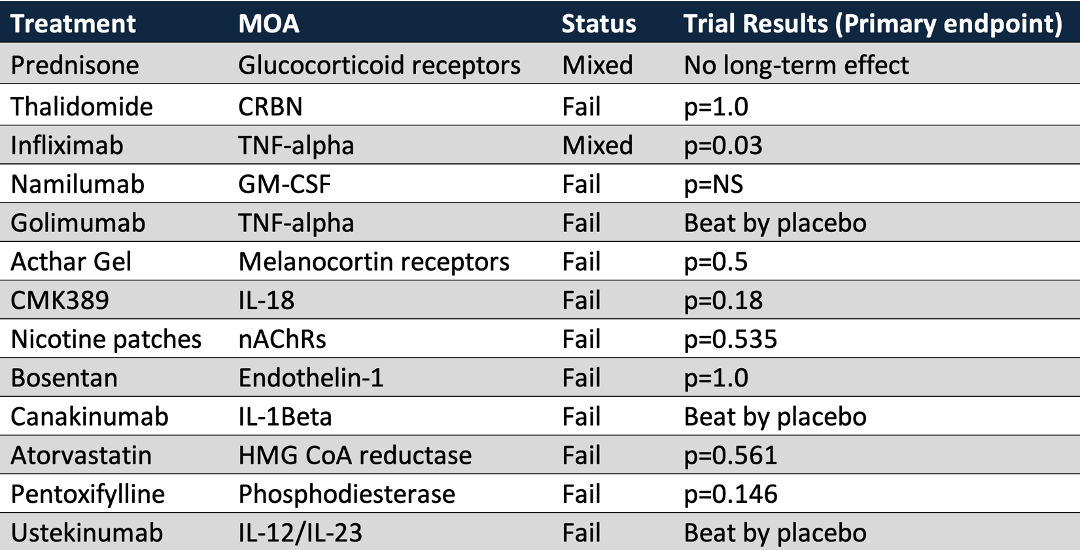
1. Efzofitimod’s mechanism of action is novel, making therapeutic efficacy highly uncertain for a disease that other drugs have struggled with. Efzofitimod is a therapeutic protein based on a naturally occurring splice variant of histidyl-tRNA synthetase (HARS) that binds to neuropilin-2 (NRP2). NRP2 has never been tested as a therapeutic target, which makes efzofitimod’s mechanism both novel and unproven. Additionally, the choice of pulmonary sarcoidosis as the lead indication further compounds the challenge. The disease is highly complex, with an unclear cause, unpredictable progression, and a history of failed drug development. There is currently no FDA-approved therapy for pulmonary sarcoidosis, despite decades of clinical attempts.[1] Even established drug classes that have shown success in other inflammatory conditions have produced only mixed results in pulmonary sarcoidosis. One notable example is infliximab, a TNF-α inhibitor with comparatively better early results that produced only mixed outcomes in larger Phase 3 trials.[2] The limited success of this well-understood pathway underscores how difficult pulmonary sarcoidosis has been to treat and highlights the high uncertainty facing a first-in-class therapy like efzofitimod.
2. Phase II results showed weak efficacy and poor transparency, leaving little basis for Phase III success. With a novel and uncertain MOA, efzofitimod required strong early clinical data to build confidence. Instead, its Phase II trial produced underwhelming results. Despite this, analysts and investors have continue propelling the stuck in anticipation of Phase III results, setting up a bearish investment opportunity.
2a. Steroid Reduction
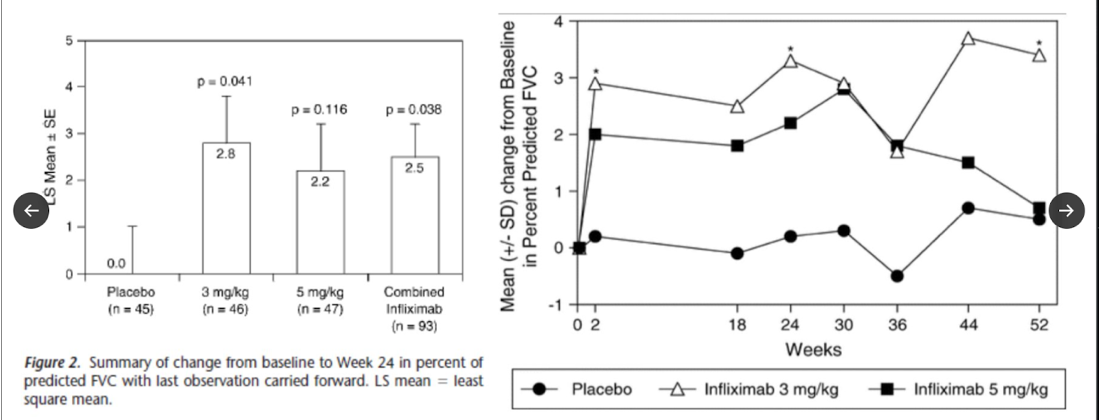
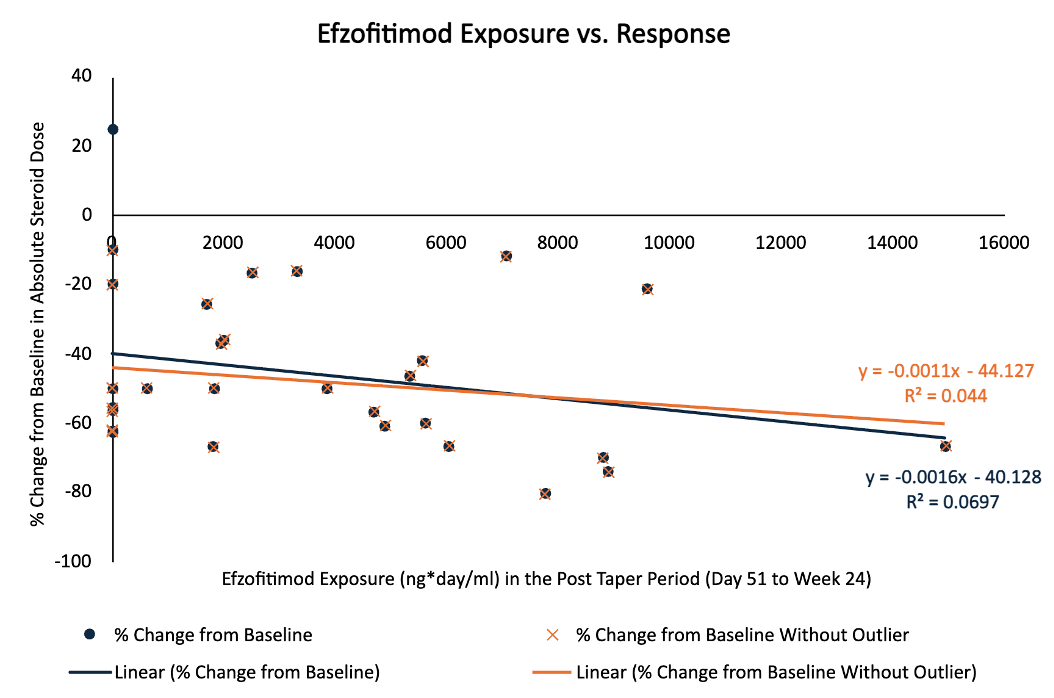
Steroid reduction is the most important metric, serving as the primary endpoint for the Phase 3 trial. On average, all efzofitimod treatment groups showed lower steroid use through Week 24 compared with placebo, with non-statistically significant baseline-adjusted relative reductions of 5%, 9%, and 22%. However, the placebo data is skewed upward by an outlier who likely relapsed.[1] This single patient increased the placebo group’s average steroid use by 6.67%, making the overall effect of efzofitimod appear more favorable than it may be. When the outlier is excluded, the placebo group demonstrates slightly greater steroid tapering than the efzofitimod groups (48.34% vs. 47.77%). This is reinforced by examining the percentage of patients who successfully tapered steroids by 50%.[2] The placebo group outperformed all efzofitimod doses, suggesting the possibility of a net negative effect. Furthermore, modest relative improvements over placebo are less clinically meaningful in context because the absolute rates of improvement are already high (e.g., 60% vs. 50%) compared with a scenario where baseline improvement is low (e.g., 10% vs. 0%). This was the case with Infliximab, which reported statistically significant improvements that did not translate into regulatory approval. This may mean that even statistically significant improvements in steroid reduction may not be sufficient to demonstrate meaningful clinical benefit or secure regulatory approval for efzofitimod.
2b. Lung Function
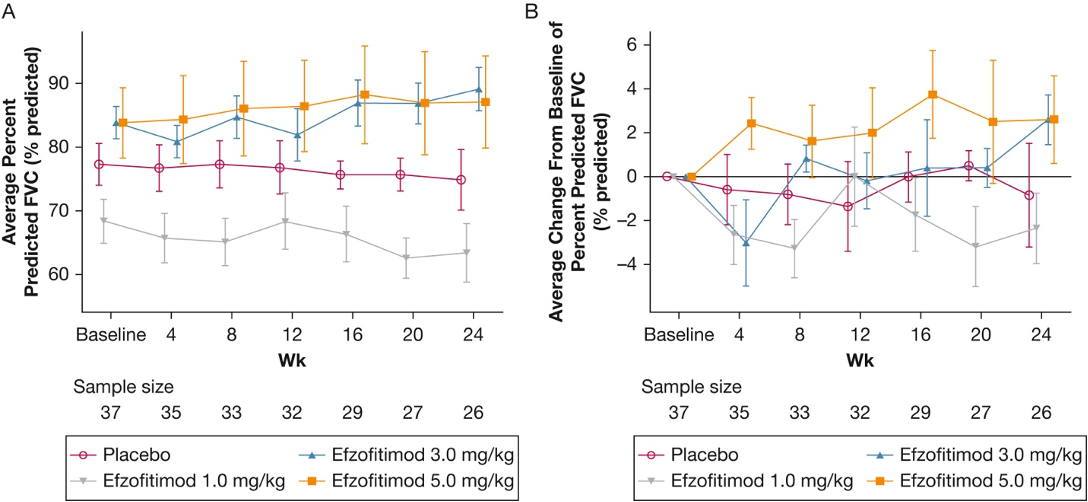
FVC is a key indicator of lung function that reflects the volume of air a patient can exhale. It was assessed in the Phase 2 efzofitimod study as a secondary endpoint. Overall, FVC % predicted declined over the study period with placebo and 1 mg/kg efzofitimod and increased with the higher doses of efzofitimod.[3] aTyr reported this as a non-statistically significant trend, although interpreting these results requires attention to the baseline imbalances among the four treatment groups. The placebo group started with an average FVC of 68.3%, while the 1 mg, 3 mg, and 5 mg groups started at 60.4%, 77.6%, and 77.3%, respectively. Patients in the 3 mg and 5 mg groups were initially healthier than those in the placebo and 1 mg groups, which may partially explain their marginally better performance. Conversely, the 1 mg group’s lower baseline relative to placebo may account for its underperformance. Pulmonary sarcoidosis is a disease that often improves naturally over time, so baseline imbalances can significantly affect outcomes, particularly if improvements in lung function are not linear across the study period.
2c. Patient Reported Outcomes
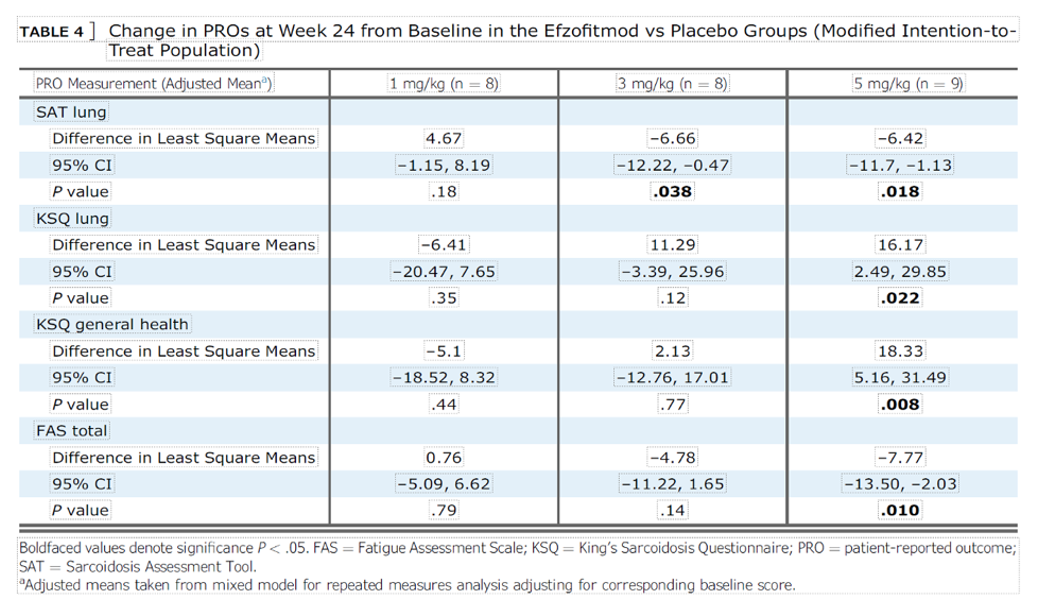
The trial also assessed patient-reported outcomes (PROs) as a secondary endpoint. While some results appear promising, PROs are inherently subjective and generally carry less weight than objective measures such as FVC or steroid reduction.[4] The accompanying graphs show very large error bars, demonstrating that the results are far from conclusive.[5] Among the PROs, the KSQ is the most important, serving as a secondary endpoint in the Phase 3 trial, yet the placebo group remains entirely within the 5 mg dose’s error bars. The company highlighted this data in its Phase 2 report to support the progression into Phase 3, but several other PRO metrics in which efzofitimod performed comparatively poorly were relegated to a supplemental data file and not mentioned in the report. The only p-values highlighted in the main report were for the four PROs that performed well. All other metrics, including additional PROs, FVC, and steroid reduction, had their p-values reported only in the supplemental data section. This selective presentation displays the poor transparency and inconclusive nature of the results.
Catalysts
1. Phase III results are released in mid-September. We anticipate that Phase III results will provide insignificant evidence to maintain optimism that efzofitmod will reach FDA approval. This event will force investors to back out as aTyr has no existing pipeline or revenue, moving the stock to cash value.
2. Indication of “strategic alternatives” or “liquidation”. Any indication from management in SEC filings, earnings calls, or presentations of strategic alternatives/liquidation will signify that aTyr is giving up their efforts, reinforcing the move to cash value or negative EV.
Risks
1. Phase 3 trials indicate significant improvement in symptoms across patients. If the phase 3 trial succeeds and aTyr finds a path towards FDA approval, the stock price is likely to hit price targets set by analysts upwards of $25.00 per share. In this case, our downside would be 316%. Given that ~36% of shares are currently shorted, the price acceleration would be dramatic making it difficult to escape. To hedge this, we suggest investing 20% upside exposure long in ATYR 0.00%↑ and 80% exposure in puts. The worst case scenario with this mix is if the stock doesn’t move which is hihghly unlikely.
Appendix
1. Table of all previous attempts to develop a treatment for pulmonary sarcoidosis. Despite some success from drugs like Infliximab, none have reached FDA approval
2. Phase 2 results of Infliximab. The data stands in stark contrast to efzofitimod, especially given that Infliximab had a significantly less healthy patient group with starting FVC <70%.
3 & 4. Secondary endpoint of efzofitimod’s phase 2 clinical trial. The graph shows the percentage change from baseline in absolute steroid dose and efzofitimod exposure for patients. The dots found on the y-axis represent the placebo group. The table below shows the number and percentage of patients who reduced steroid use by 50%, split by dosage.

5. Secondary endpoint of efzofitimod’s phase 2 clinical trial. The graphs show the show changes in FVC (lung function) over the duration of the trial. Baseline imbalances can be observed on the graph on the left.
6 & 7. Secondary endpoint of efzofitimod’s phase 2 clinical trial. Values in bold indicate statistical significance. For KSQ lung and KSQ general health, higher scores indicate improvement. For SAT lung and FAS total, lower scores indicate improvement.
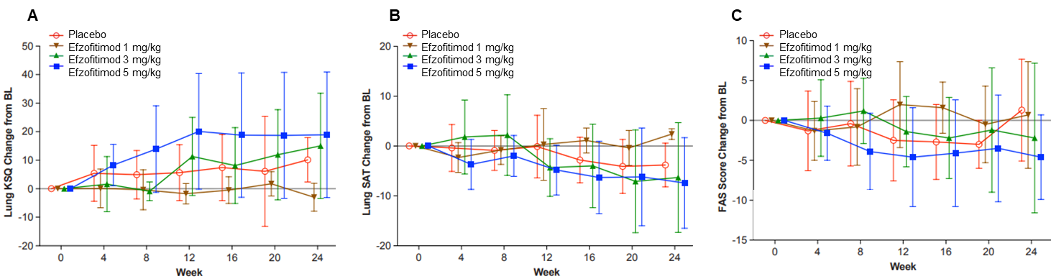
Change in patient-reported outcomes (PROs) presented as change from baseline x treatment week for Lung KSQ (A), Lung-SAT (B), and FAS-Total. All data is represented as mean(SD).