

Elevator Pitch
With the stock trading near its 52-week low, we see an asymmetric investment opportunity driven by under-appreciated spectrum asset value and contract acquisition potential, upcoming federal regulatory tailwinds, and potential strategic interest.
Background & Summary
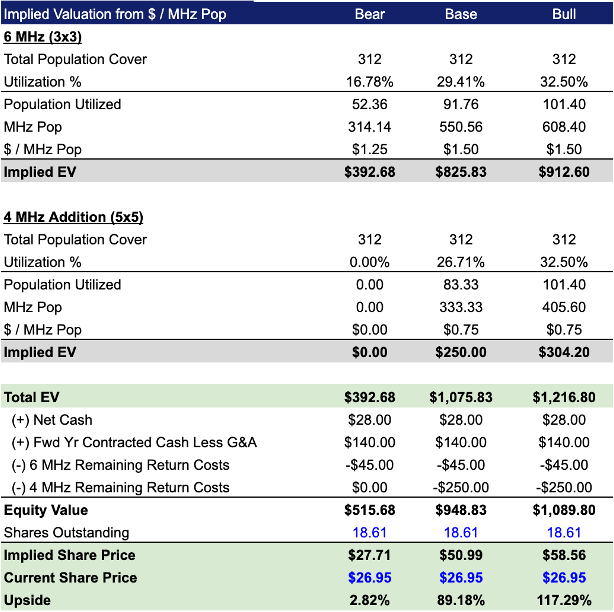
Anterix Inc. enables utility companies to operate private LTE networks for smart-grid management, grid monitoring, and disaster control using its 900 MHz spectrum network. In 2019, ATEX successfully lobbied the FCC to repurpose its narrowband licenses to broadband, opening access to new markets and premium pricing. The company has since secured three long-term broadband leasing agreements and three purchasing agreements, while controlling over 50% of the 900 MHz spectrum nationally, fortifying their broadband moat. Despite these advantages and a quoted $3.2 billion in potential contract value from 60+ utility companies, ATEX trades at a price that assumes zero further contract closings and no increase in spectrum utilization. The market appears to be mispricing ATEX due to overblown concerns about private LTE demand, contract transparency, and regulatory exposure, but we are confident near-term catalysts, including an FCC rulemaking decision, a new and experienced CEO focused on growth and transparency, and a Morgan Stanley-led strategic review, will close this valuation gap. We initiate a 12-month price target of $50.99, implying 89.18% upside.
Investment Thesis
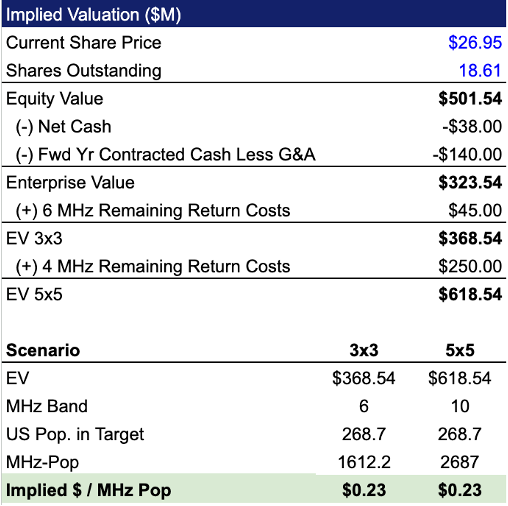
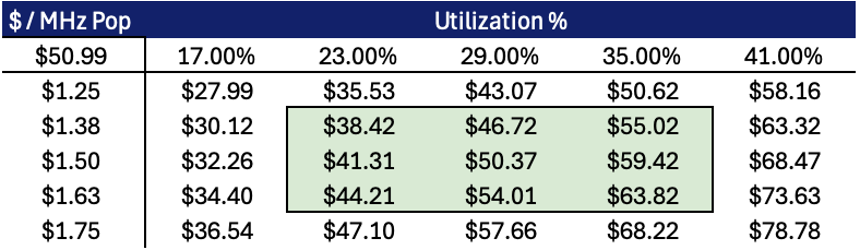
Anterix is trading at a severe discount to its potential utilization rate, reflecting a dislocation between public market sentiment and real-world spectrum demand. As shown in our MHz/Pop valuation model, ATEX trades at just $0.23/MHz-Pop1, implying maximum potential spectrum utilization of 16.78%. Since ATEX’s current utilization is already 13.87%, this means the market anticipates a modest 2.91 percentage point utilization increase in our 12-month investment timeline. Given their new CEO (1/25) Scott Lang’s experience in utility sales, contract acquisition salary incentives, and backing from an ecosystem of 100+ vendors and utility partners, we believe it is reasonable for the base case model to assume 29.4% spectrum utilization2. Conservatively, assuming the NPV of ATEX’s expansion to the 5x5 bandwidth to be ~$0, at 29.4% utilization with a $1.50/MHz-Pop3 deal price, we find an implied share price of $50.99, representing 89.18% upside. In a bear case, with just $1.25/MHz-Pop deal prices and the market’s very own implied 16.78% utilization, we still find upside at 2.82% – all assuming no upgrade to the 5x5 network.
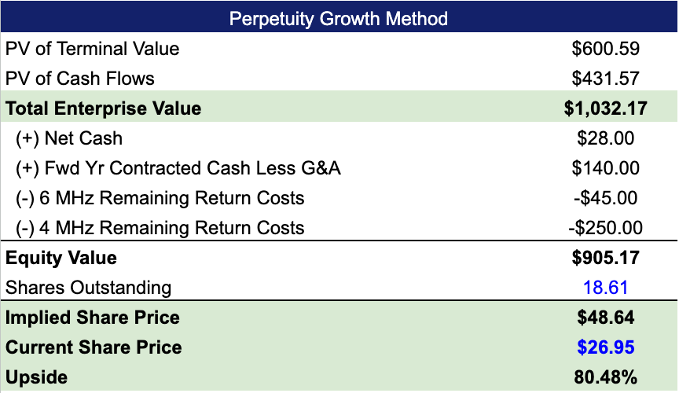
While Anterix's spectrum pricing power is well-established, the core driver of long-term value lies in converting likely utility customers to revenue-generating contracts. According to ATEX, their assets represent $3.2B in potential value across the spectrum market. Over the next eight years, we assume ATEX converts 10.3%4 of Tier 1 customers (potential customers who have demonstrated interest) to revenue-generating contracts and 5.7% of Tier 2 customers (potential customers who haven’t demonstrated interest) into Tier 1 customers, based on historical closing rates and pipeline disclosures from the last 8 quarters. As shown in our model, this drives $1.03B in total enterprise value, $431M from near-term cash flows and $600M from the terminal value. This leads to an implied share price of $48.64, representing 80.48% upside. Importantly, this model assumes no further contract acceleration; rather, it reflects continued base-rate execution across the existing pipeline. Only a fraction of ATEX’s addressable Tier 2 companies have been tapped thus far - approximately $500M out of $3.2B - leaving 85% of the opportunity still on the table.
The potential FCC 5x5 block approval increases spectrum deal prices and accelerates Tier 1 contract conversion, thus overall spectrum utilization. ATEX’s proposed expansion from a 3x3 to a 5x5 block would align its 900 MHz spectrum with global LTE standards, removing the need for specialized hardware and enabling broader grid use cases. This shift directly addresses a key barrier for Tier 1 utility customers, many of whom have cited technical limitations as a reason for delayed contracting. With 75% of incumbent licensees already cleared and historical FCC timelines averaging 14 months, a ruling could arrive by early 2026, aligning with our 12-month investment timeline. Of course, a premium 5x5 block expansion would demand higher prices, but when new Tier 1 customers sign up for the 5x5 block expansion, naturally, spectrum utilization rates will increase. Upon an FCC approval, we expect ATEX to command premium deal prices and experience accelerated contract conversion, boosting utilization rates closer to 32.5%, leading to upwards of 117.29% upside as shown in our bull case $ / MHz-Pop model.
Catalysts
FCC Regulatory Ruling: The FCC’s 5x5 rulemaking could finalize as early as Q1-Q2 2026 based on historical timelines. With 75% of legacy incumbents already cleared and no technical opposition filed, regulatory odds appear quite favorable. Newly appointed FCC Chair Brendan Carr is seen as a strong supporter of expanding the 900 MHz band, having previously voted for the initial 3x3 MHz allocation and expressing a belief that the FCC should enhance the band’s capabilities. We believe that his past support and current leadership position within the FCC make it probable that he will back the 5x5 MHz expansion, ensuring approval and rulemaking proceeding along the lines originally advocated by ATEX. While the market has effectively priced in zero total value-add for this scenario due to continued uncertainty over contract execution - the share price has net decreased since the announcement - a successful ruling would immediately expand ATEX’s spectrum capacity by 67%, creating monetization optionality across both new and existing contracts. Monetization of this 5x5 block would also very likely bring ATEX increased contract conversion, as many utility customers are seeking premium 5x5 spectrum services prior to finalizing contracts with ATEX.
New CEO Brings Increased Pipeline Transparency and Deal Flow: The recent appointment of Scott Lang as CEO in January 2025 marks a strategic inflection point for ATEX, bringing operational focus, economic discipline, and a shift toward measurable execution. Lang, who previously scaled and sold a utility-focused business, has already announced a 20% G&A cost reduction and authorized a $4M share buyback (1% of market cap). Unlike the previous CEO, Lang’s compensation aligns with shareholders, as his 100% salary bonus is tied entirely to contract signings and 5x5 regulatory approval. Additionally, Lang is being granted stock options that trigger above a share price of $34—26% above current share price. Under his leadership, ATEX has already enhanced its Demonstrated Intent (DI) scorecard, offering greater transparency into its $3.2B pipeline by flagging 18 utilities ($1B in potential value) that have advanced to active engagement. We believe that Lang’s expertise, ambition, and strong incentives position ATEX well for future contract signings after he settles into his new position.
Morgan Stanley Strategic Review: Morgan Stanley has been assisting ATEX with their strategic review process to capitalize on the growing demand and urgency for private wireless broadband solutions for the utility industry. Two days after this announcement, the stock jumped from $28 to $42, reflecting investor anticipation of a potential buyout at a premium to current $/MHz-Pop valuations. Sentiment has since cooled off and the stock has settled back to around $27 – a price floor that has held for 5 years – as investors impatiently await further announcements or new contract signings. Given the scarcity of comparable deals in this niche spectrum space, a successful transaction could unlock significant upside relative to current market pricing. In this scenario, an acquisition would likely be at a significantly higher multiple than the current $0.23 MHz/Pop (or implied maximum 16.78% utilization) that the market is pricing.
Risks
FCC Approval Risk for Spectrum Expansion: ATEX faces regulatory uncertainty regarding its petition to expand the 900 MHz band from 3x3 MHz to 5x5 MHz. While the company believes its joint petition with 7 utilities and 2 trade associations aligns with FCC policies and priorities, the commission may respond with anything from full approval to dismissal. Filed in February 2024, the process has already taken significant time and resources, with no guarantee of success. If rejected, ATEX would remain constrained to its current spectrum capacity, limiting growth opportunities and requiring additional management focus on alternative solutions. Given the risk, we valued ATEX with a $0 NPV transition to a 5x5 block and still arrived at a steep discount to intrinsic value, reinforcing that ATEX is not dependent on favorable FCC ruling.
Competition from Third Parties: ATEX faces competition from telecom giants (Verizon, AT&T, T-Mobile, EchoStar) and private radio operators with deeper resources, established utility relationships, and greater regulatory influence. Examples include FirstNet (a newly created federal 700 MHz distributor) and the announced sale of T-Mobile’s 800 MHz spectrum holdings to Grain, a PE group, which intends to market the band as an equivalent to ATEX’s 900 MHz assets. While this may put pricing pressure on ATEX during contract negotiations, ATEX’s 900 MHz band remains the most competitive because it is purpose-built for utilities and grid modernization, having already been consolidated into a 3x3 block. In contrast, 700 MHz bands are congested with consumer mobile traffic and 800 MHz bands are highly fragmented, making it more challenging to convert into broadband. The bigger risk is if 700 and 800 MHz bands are consolidated by telecom giants who can afford the $100M+ transformation over several years, although T-Mobile’s recent sale of 800 MHz band displays how this is not the direction of industry trends. Ironically, Grain entering the spectrum market strengthens our thesis as it demonstrates that investment professionals are noticing the underappreciated demand for spectrum.
Cash Runway: ATEX’s current financials require consistent lease or purchase agreement signings to stay net cash positive. If they fail to continue signing new deals, they are at risk of using up their 60.6M cash runway by Q4 2027, forcing them to issue debt or dilute shares. However, ATEX has $0 in debt outstanding and $150 million in uncollected contract proceeds, with roughly $80 million scheduled to be received during the fiscal year ending March 31, 2026. ATEX’s aggressive $250 million buyback program and $250 million AnterixAccelerator initiative also display management’s confidence that new leases will be signed, and current ones renewed.
Financial Models
Implied $ / MHz Pop Asset Valuation Model1
Implied Share Price Valuation Model2
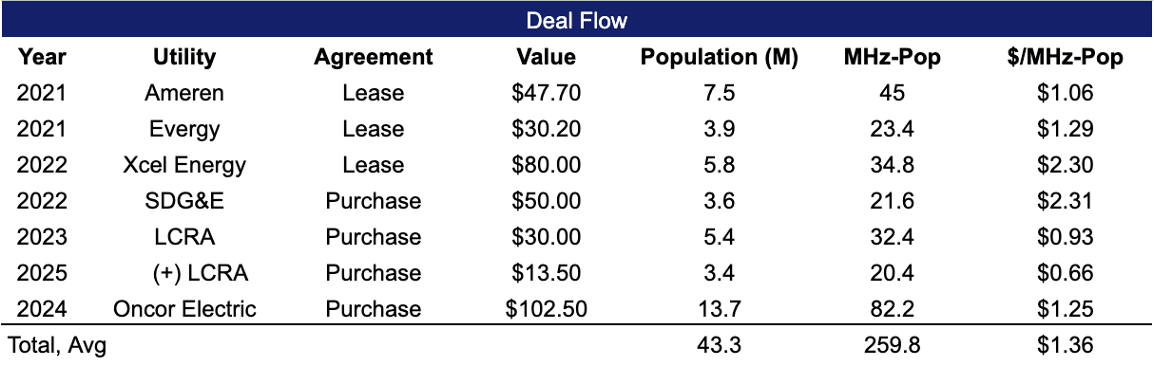
Anterix Precedent Transactions from Lease and Purchase Agreement3
Cash Flow Estimates & DCF Valuation4
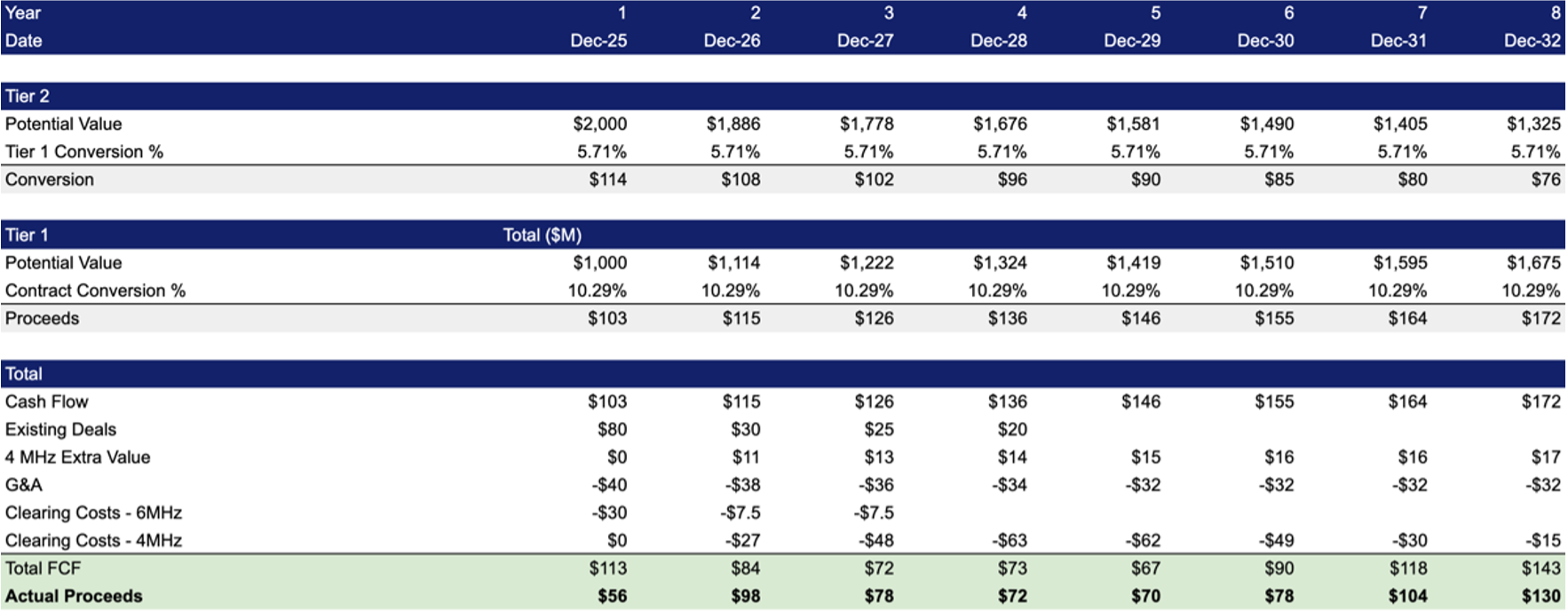
Tier 1 Conversion = $ Value Converted from Tier 2 --> Tier 1 / Total Tier 2 Value / # Years -----> 5.71%
Contract Conversion % = $ Value Contracts Secured / # Years / $Value Tier 1 -----> 10.29%
Our clearing costs estimate for the 4MHz band assumes approximately double the $125M in clearing costs for the 6MHz 3x3 block = $250M
“Actual Proceeds” accounts for the contract structure of ATEX’s deal signings, which primarily consist of two equal lump sum payments – an initial upfront payment, with the remaining spread over the following 12 months
Asset Valuation and Spectrum Utilization Implied Share Price Sensitivity Analysis
Rice Securities Investment Group May 29, 2025